
Artificial Intelligence (AI) is no longer just a trending topic—it has become the foundation of modern innovation. From smartphones to healthcare systems, AI is deeply integrated into our daily lives. In 2026, AI technologies are evolving at an unprecedented pace, transforming how businesses operate and how people interact with technology.
This comprehensive guide explores the top AI technologies in 2026, their real-world applications, benefits, challenges, and what the future holds.
What is Artificial Intelligence?
Artificial Intelligence refers to machines or software that can simulate human intelligence, including learning, reasoning, problem-solving, and decision-making.
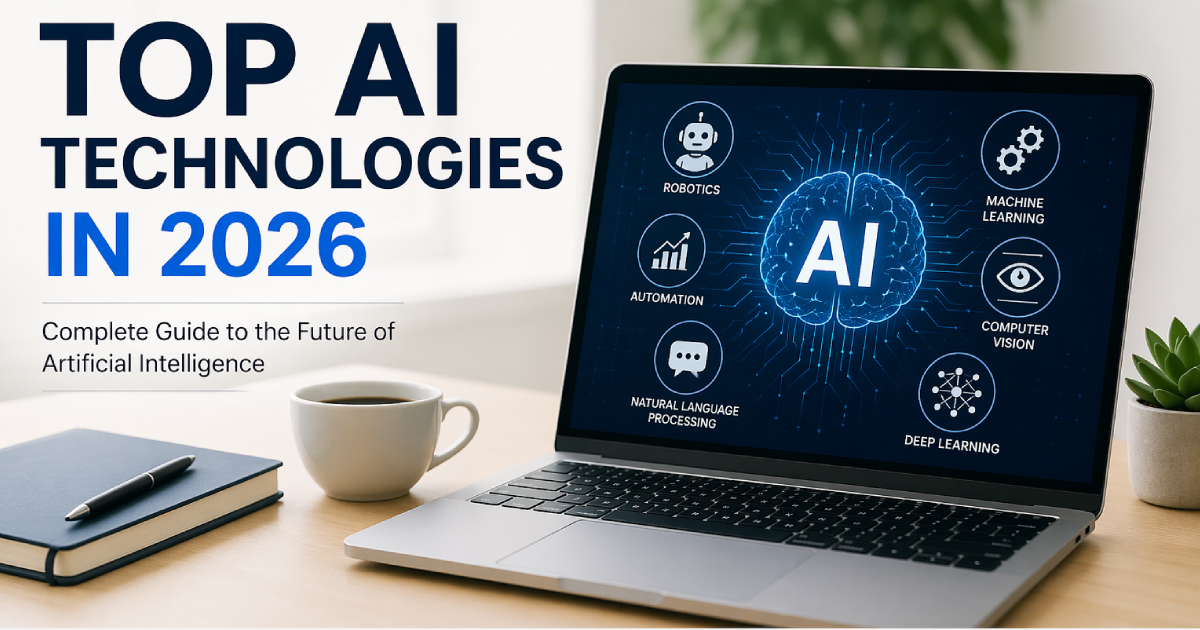
AI systems are powered by technologies such as:
- Machine Learning (ML)
- Deep Learning
- Natural Language Processing (NLP)
- Computer Vision
In 2026, AI is shifting from being a “tool” to becoming an independent decision-maker.
1. Agentic AI (Autonomous AI Systems)
Agentic AI is the most advanced and fastest-growing AI trend in 2026.
Unlike traditional AI, which only responds to commands, Agentic AI can:
- Plan tasks
- Make decisions
- Execute actions independently
Example:
Imagine an AI that can:
- Research a topic
- Write a blog post
- Publish it
- Promote it on social media
All without human intervention.
Why It Matters:
- Reduces human workload
- Improves efficiency
- Enables full automation
Challenges:
- Ethical concerns
- Loss of human control
- Security risks
Agentic AI is expected to revolutionize industries like marketing, finance, and customer service.
2. Generative AI 2.0 (Smarter Content Creation)
Generative AI has significantly improved in 2026. It is now:
- More accurate
- Context-aware
- Less prone to errors
What It Can Do:
- Write articles, scripts, and emails
- Generate images and videos
- Create music and code
Real-World Use:
- Bloggers create content faster
- Designers generate visuals instantly
- Developers write code using AI
Key Advantage:
Generative AI is now a productivity multiplier, helping individuals and businesses scale quickly.
3. Multi-Agent AI Systems
Instead of one AI system, companies are now using multiple AI agents working together.
How It Works:
- One AI handles research
- Another writes content
- Another analyzes data
Together, they function like a team of digital employees.
Benefits:
- Faster workflows
- Better task specialization
- Increased scalability
This system is becoming popular in enterprise-level businesses.
4. Edge AI (Real-Time Intelligence)
Edge AI processes data locally on devices instead of cloud servers.
Examples:
- Smartphones
- Smart cameras
- IoT devices
Benefits:
- Faster processing
- Better privacy
- Reduced internet dependency
Use Cases:
- Self-driving cars
- Smart homes
- Industrial automation
Edge AI is crucial for applications where speed and privacy are critical.
5. AI + Robotics (Physical AI)
AI is now entering the physical world through robotics.
Applications:
- Manufacturing robots
- Delivery drones
- Autonomous vehicles
Impact:
- Increased efficiency
- Reduced human labor
- Improved safety
Future:
Robots powered by AI will become more human-like and intelligent, capable of complex tasks.
6. AI in Healthcare and Science
AI is revolutionizing healthcare and scientific research.
Key Uses:
- Disease diagnosis
- Drug discovery
- Personalized medicine
Example:
AI can analyze medical data and detect diseases earlier than human doctors.
Benefits:
- Faster treatments
- Better accuracy
- Reduced costs
AI is expected to play a major role in solving global health challenges.
7. AI Cybersecurity and Ethical AI
As AI grows, so do risks. That’s why AI security and ethics are crucial.
AI in Cybersecurity:
- Detects threats in real-time
- Prevents cyber attacks
- Identifies vulnerabilities
Ethical AI:
- Transparent decision-making
- Bias reduction
- Responsible AI usage
Challenges:
- AI misuse
- Privacy concerns
- Regulation issues
Building trustworthy AI systems is a top priority in 2026.
8. AI-Native Software Development
AI is changing how software is built.
Features:
- AI-generated code
- Automated debugging
- Low-code platforms
Impact:
- Faster development
- Reduced need for coding skills
- Increased innovation
Even beginners can now create applications using AI tools.
9. AI Infrastructure and Computing Power
Behind every AI system is powerful infrastructure.
Key Components:
- GPUs and TPUs
- Cloud computing
- Data centers
Why It Matters:
AI models require massive computing power to function effectively.
Trend:
Companies are investing billions in AI infrastructure to stay competitive.
10. AI in Everyday Life
AI is becoming part of daily life.
Examples:
- Voice assistants
- Smart recommendations
- AI-powered apps
Impact:
- Personalized experiences
- Increased convenience
- Better decision-making
AI is now everywhere, from shopping apps to education platforms.
Benefits of AI Technologies
AI offers numerous advantages:
✅ Efficiency
Tasks are completed faster and more accurately.
✅ Cost Reduction
Automation reduces operational costs.
✅ Innovation
AI enables new products and services.
✅ Scalability
Businesses can grow faster using AI tools.
Challenges of AI in 2026
Despite its benefits, AI also faces challenges:
- Data privacy concerns
- Job displacement
- Ethical issues
- High development costs
Addressing these challenges is essential for sustainable growth.
Future of AI: What’s Next?
The future of AI looks incredibly promising.
Predictions:
- AI will become more human-like
- Autonomous systems will dominate
- AI will replace repetitive jobs
- Human-AI collaboration will increase
AI is moving toward becoming a true partner in decision-making.
Conclusion
Artificial Intelligence in 2026 is not just evolving—it is transforming the world. From Agentic AI to smart robotics, these technologies are reshaping industries and redefining how we live and work.
For bloggers, entrepreneurs, and businesses, understanding these trends is essential to stay competitive.
The key takeaway:
Those who adapt to AI early will lead the future, while others risk being left behind.