
Introduction: The Real Reason Modern Devices Feel So Smart
A few years ago, buying a laptop was simple.
People mostly checked:
- RAM
- storage
- battery
- maybe processor generation
That was enough.
But now?
Suddenly everyone is talking about:
- AI processors
- neural engines
- dedicated AI chips
- NPUs
- 3nm architecture
- AI PCs
- gaming CPUs
- machine learning acceleration
And honestly, many people feel confused.
Because processors are no longer just “computer parts.”
They are becoming intelligent systems that decide how efficiently your entire device performs.
The reason modern smartphones can:
- remove background noise during calls
- improve photos instantly
- translate languages live
- generate AI images
- run heavy games smoothly
is because processors have evolved massively.
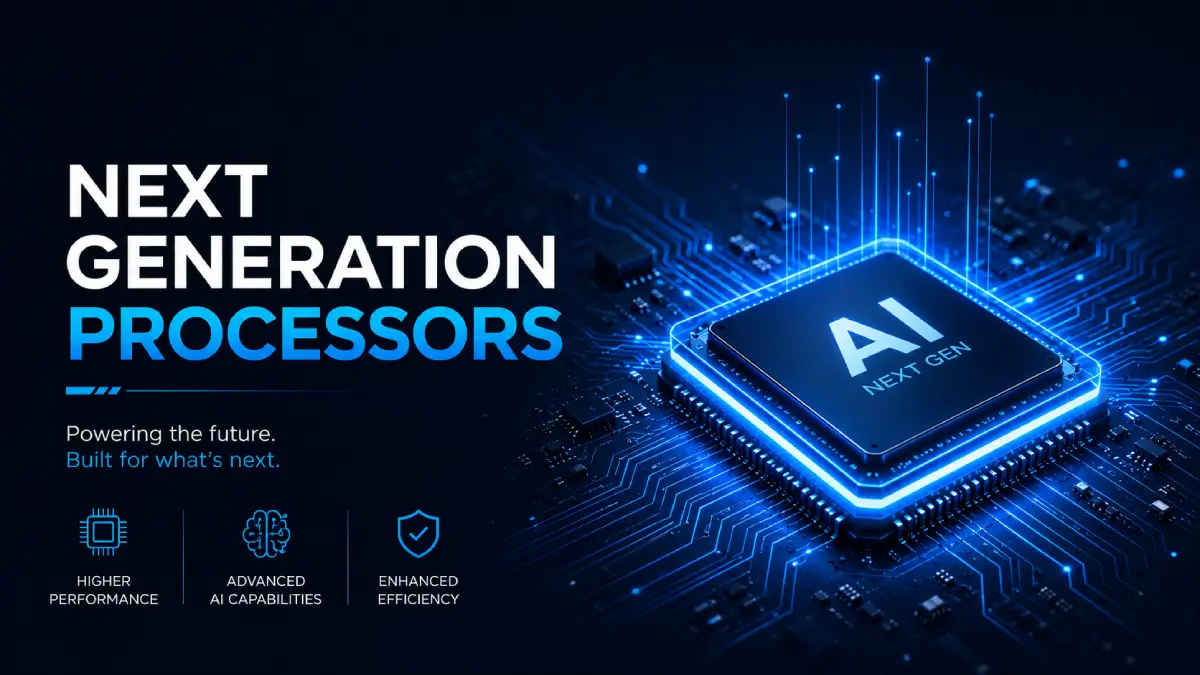
Next Generation Processors
These processors are not just faster.
They are smarter, more power-efficient, AI-ready, and built for the future.
In this guide, we’ll understand:
- what next generation processors actually are
- why companies are investing billions into them
- how AI is changing chip design
- why modern devices feel dramatically faster
- where processor technology is heading next
And I’ll explain everything in simple human language — without making it feel like an engineering textbook.
What Are Next Generation Processors?
Next generation processors are advanced computing chips designed to handle modern workloads more intelligently and efficiently than traditional processors.
Older processors mainly focused on:
- raw speed
- basic multitasking
- simple computing operations
Modern processors are built for much more.
They now handle:
- Artificial Intelligence
- real-time graphics rendering
- machine learning
- smart battery optimization
- voice processing
- cloud workloads
- advanced gaming
- data-heavy applications
A next generation processor is a smarter and more efficient brain for modern devices.
Modern software has become extremely demanding.
Think about daily activities now.
A normal user today might:
- attend video meetings
- edit reels
- stream 4K videos
- use AI tools
- play online games
- run multiple apps simultaneously
All of this requires enormous processing power.
Traditional processors struggle with:
- heat generation
- battery consumption
- AI workloads
- heavy multitasking
That’s why companies are redesigning processors from the ground up.
The Biggest Difference Between Old and New Processors
Older processors were mainly designed to “execute instructions.”
Next generation processors are designed to:
- analyze workloads
- optimize performance automatically
- improve efficiency intelligently
- process AI tasks directly on the device
This changes the entire computing experience.
Real-Life Example: Why Modern Phones Feel Smarter
Have you noticed how modern smartphones:
- enhance photos instantly
- blur backgrounds automatically
- recognize faces quickly
- improve voice clarity during calls
That’s not happening magically.
The processor inside the phone is using AI acceleration in real time.
A few years ago, these tasks needed powerful desktop computers.
Now they happen instantly inside your pocket.
That’s the power of next generation processors.
Key Features of Next Generation Processors
1. Built-In AI Processing
This is probably the biggest change.
Modern processors now include:
- AI engines
- Neural Processing Units (NPUs)
- Tensor cores
- Machine learning accelerators
These components are specifically designed for AI-related tasks.
This helps devices:
- process AI faster
- reduce cloud dependency
- improve privacy
- save battery
2. Better Energy Efficiency
Earlier processors consumed more power and generated significant heat.
Now companies use advanced semiconductor manufacturing technologies like:
- 7nm
- 5nm
- 3nm
Smaller transistors allow:
- lower power consumption
- better battery life
- improved thermal efficiency
- faster processing
This is especially important for:
- laptops
- smartphones
- tablets
- wearable devices
3. Faster Multitasking
Modern processors are designed for real-world usage.
People rarely use just one application anymore.
A next generation processor can easily handle:
- video calls
- background downloads
- browser tabs
- editing software
- AI tools
all simultaneously without slowing down.
4. Improved Graphics Performance
Gaming and creative work demand powerful graphics handling.
Modern processors now include advanced GPUs capable of:
- ray tracing
- 3D rendering
- AI upscaling
- realistic lighting effects
This improves:
- gaming
- animation
- video editing
- AR/VR experiences
Types of Next Generation Processors
AI Processors
These are designed specifically for:
- machine learning
- neural networks
- AI computations
AI processors are heavily used in:
- smartphones
- cloud servers
- robotics
- autonomous vehicles
Mobile Processors
Companies like:
- Qualcomm
- Apple
- MediaTek
are developing extremely efficient smartphone processors.
Modern mobile chips now rival some laptop processors in performance.
That’s honestly incredible when you think about it.
Gaming Processors
Gaming CPUs focus heavily on:
- high frame rates
- low latency
- advanced graphics rendering
- thermal optimization
Modern games require enormous computing power.
That’s why gaming processors evolve rapidly.
Cloud & Server Processors
Massive companies like:
- Amazon
- Microsoft
run gigantic data centers.
These require ultra-powerful processors capable of handling:
- cloud computing
- AI training
- billions of user requests
every single second.
Quantum Processors
This is where things become truly futuristic.
Quantum processors don’t work like traditional CPUs.
Instead of regular binary calculations, they use quantum mechanics.
Potential future applications include:
- advanced scientific research
- climate simulations
- drug discovery
- military-grade encryption
- impossible mathematical calculations
Quantum computing is still developing, but it may completely redefine technology in the future.
How AI Is Changing Processor Design
Artificial Intelligence is currently one of the biggest reasons processor technology is evolving aggressively.
Traditional CPUs alone are no longer enough.
Modern AI applications require:
- parallel computing
- neural acceleration
- ultra-fast memory access
That’s why companies are creating dedicated AI hardware.
This allows devices to:
- process AI locally
- reduce internet dependency
- improve speed significantly
Apple Changed the Industry Completely
One of the biggest turning points came when Apple introduced its M-series chips.
People were shocked because:
- battery life improved massively
- laptops became quieter
- performance jumped dramatically
- heat generation reduced significantly
This forced the entire industry to rethink processor design.
Suddenly efficiency became just as important as raw power.
ARM vs x86: The Processor Battle
ARM Architecture
ARM processors focus heavily on:
- battery efficiency
- lower heat
- mobile optimization
That’s why smartphones rely heavily on ARM chips.
Now even laptops are shifting toward ARM-based designs.
x86 Architecture
x86 processors are traditionally known for:
- high performance
- gaming capability
- software compatibility
These processors dominate:
- desktop PCs
- gaming systems
- workstations
ARM vs x86 Comparison
| Feature | ARM | x86 |
| Battery Life | Excellent | Moderate |
| Heat Generation | Lower | Higher |
| Gaming | Improving | Excellent |
| Mobile Devices | Dominant | Limited |
| Software Compatibility | Growing | Very Strong |
Why Next Generation Processors Matter for Everyday Users
Many people think processor technology only matters to gamers or developers.
That’s no longer true.
Even normal users benefit directly.
Better Smartphone Experience
Apps open faster.
Photos process instantly.
The battery lasts longer.
Faster Office Work
Tasks like:
- Excel calculations
- Zoom meetings
- browser multitasking
become smoother.
Better Content Creation
Modern processors help creators:
- edit videos faster
- render animations quickly
- process AI tools efficiently
Improved Gaming
New processors improve:
- FPS stability
- graphics quality
- loading times
- streaming performance
Biggest Challenges in Processor Development
Heat Management
More performance often creates more heat.
Engineers constantly work on:
- advanced cooling
- efficient chip design
- thermal optimization
Rising Manufacturing Costs
Modern semiconductor factories cost billions of dollars.
Chip development is becoming extremely expensive.
Global Chip Shortages
A few years ago, semiconductor shortages affected:
- cars
- smartphones
- gaming consoles
- laptops
This proved how critical processors are for the global economy.
Future of Next Generation Processors
The future looks genuinely exciting.
Upcoming innovations may include:
- AI-native processors
- brain-inspired computing
- ultra-efficient wearable chips
- advanced robotics processors
- quantum computing integration
Devices may become:
- smarter
- more personal
- more autonomous
than ever before.
Expert Tips Before Buying a Processor
Don’t Buy Only Based on Marketing
Many people blindly buy expensive processors without understanding their needs.
Choose according to your usage.
Prioritize Efficiency Too
Performance matters.
But cooling and battery life matter equally.
Think About Future AI Applications
AI software demand is increasing rapidly.
Buying slightly future-proof hardware is often a smart decision.
Common Mistakes People Make
Assuming More Cores Always Means Better Performance
Processor architecture matters just as much.
Ignoring Thermal Performance
Poor cooling reduces long-term performance significantly.
Overspending for Basic Usage
Not everyone needs a high-end gaming processor.
Pros and Cons of Next Generation Processors
| Pros | Cons |
| Faster performance | Higher cost |
| Better AI support | Heat challenges |
| Improved battery life | Rapid upgrades |
| Better gaming | Expensive manufacturing |
| Smarter computing | Compatibility limitations sometimes |
Final Thoughts: The Future Will Be Built on Smarter Chips
Technology is evolving faster than most people realize.
Artificial Intelligence, smart devices, automation, cloud computing, robotics — all of it depends on processing power.
And processors are no longer just hardware components hidden inside machines.
They are becoming intelligent digital brains.
The next decade will likely bring:
- smarter devices
- faster AI systems
- realistic virtual experiences
- advanced automation
And next generation processors will sit at the center of all of it.
Understanding processor technology today isn’t just for tech enthusiasts anymore.
It’s becoming part of understanding the future itself.
Also read this post:
BGMI 4.4 Update Released: New Hero’s Crown Mode, Flying Powers, Ancient Temples & More
Cybersecurity Habits That Can Save You from Hackers
Frequently Asked Questions (FAQs)
What is a next generation processor?
A next generation processor is an advanced CPU designed with AI capabilities, better efficiency, faster speed, and modern workload optimization.
Why are AI processors important?
AI processors handle machine learning tasks faster and more efficiently than traditional CPUs.
Which companies are leading processor innovation?
Major companies include:
1. Intel
2. AMD
3. Apple
4. NVIDIA
5. Qualcomm
Are next generation processors better for gaming?
Yes. They improve:
1. frame rates
2. graphics quality
3.rendering speed
4.multitasking
What is the future of processors?
Future processors may include:
1. quantum computing
2. AI-native chips
3. ultra-efficient architectures
4. advanced neural engines
CTA
Which future processor technology excites you the most — AI chips, gaming CPUs, or quantum processors?
Share your thoughts and stay updated with the latest innovations shaping the future of computing.