

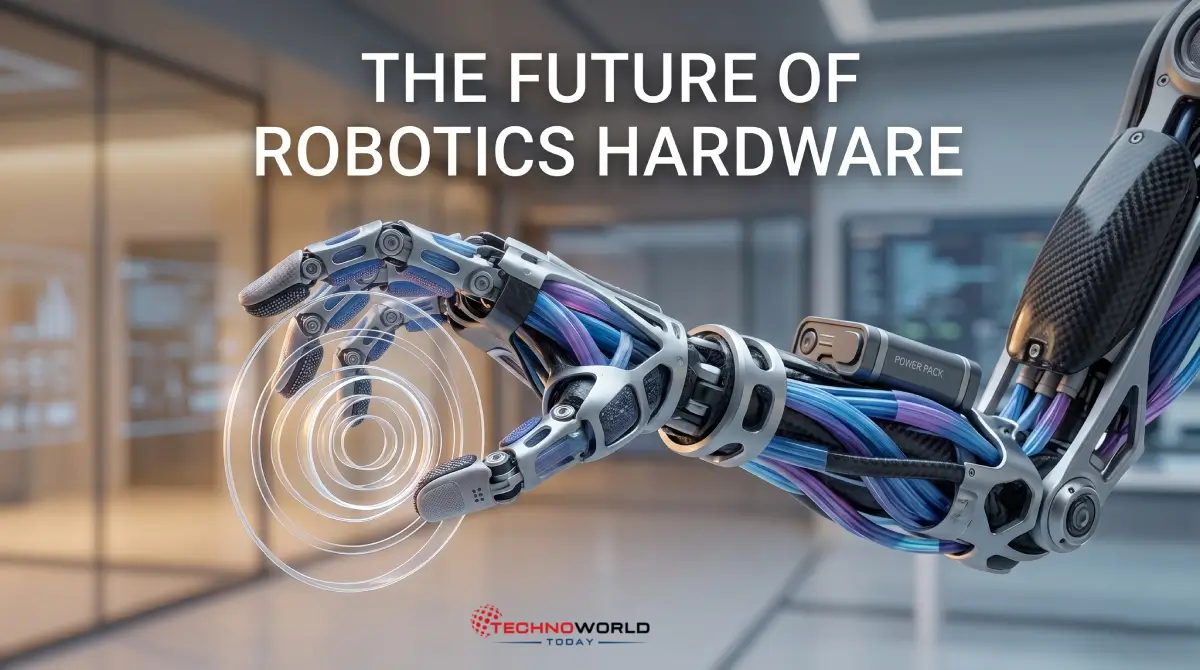
When we speak about the rapid acceleration of technology, our conversations almost always revolve around Artificial Intelligence (AI), machine learning models, and complex cloud software. We marvel at how a digital “brain” can process billions of data points in milliseconds. However, in our fascination with the digital mind, we often overlook the physical body. A brilliant brain is effectively paralyzed without a capable physical form to execute its commands.
As we progress through 2026, a silent but monumental paradigm shift is occurring. The real revolution that will define this decade is not just happening in lines of code, but in the physical anatomy of machines. The future of robotics hardware is moving away from the rigid, heavy steel frames of the past and transitioning into a new era of biology-inspired, ultra-efficient, and highly adaptive structural engineering.
This comprehensive guide explores the deep-tech mechanical upgrades, novel material sciences, and innovative hardware architectures that are giving AI a body worthy of its intelligence.
The Core Problem with Legacy Robotics Hardware
To appreciate where robotics hardware engineering advancements are taking us, we must first look at the limitations of traditional systems. For the past fifty years, industrial automation relied on a simple formula: heavy iron castings, high-voltage alternating current (AC) motors, and massive gearboxes with high reduction ratios.
While these machines excel at repeating the exact same path within a millimeter of accuracy inside a factory cage, they suffer from fundamental flaws when introduced to the real world:
- Extreme Weight-to-Payload Ratios: A traditional industrial arm capable of lifting a 10 kg weight often weighs over 50 kg itself. This makes mobile deployment highly energy-inefficient.
- High Mechanical Impedance: Legacy joints are stiff. If a rigid robot collides with an object or a human, it does not absorb the impact; it transfers all the destructive kinetic energy directly to the obstacle.
- High Power Demands: Heavy structural components require continuous, immense power draws, tethering machines to wall outlets or draining massive battery packs within minutes.
The next generation of hardware completely dismantles this old engineering blueprint.
1. Soft Robotics Technology: Merging Machine with Biology
One of the most fascinating domains reshaping the industry is soft robotics technology. Instead of constructing robots exclusively from aluminum and steel, hardware engineers are leveraging flexible, elastic materials like silicone, polyurethane, and specialized advanced hydrogels.
Elastomers and Fluidic Actuators
Soft robots often drop traditional mechanical gears altogether. Instead, they utilize fluidic or pneumatic networks embedded within elastomeric structures. By pumping air or bio-compatible fluids into specific channels, the material deforms in highly controlled ways—mimicking the organic movements of an elephant’s trunk, a human tongue, or an octopus arm.
Real-World Use Cases for Soft Hardware
- Delicate Supply Chain Automation: Standard mechanical grippers struggle to pick up irregular, soft, or fragile items like fresh agricultural produce, eggs, or light glass vials. Soft grippers organically wrap around the contours of an object, distributing pressure evenly without crushing it.
- Minimally Invasive Medical Tools: In healthcare, rigid surgical tools risk puncturing internal tissue. Soft robotic catheters can seamlessly snake through complex blood vessels, minimizing patient trauma and drastically reducing recovery times.
2. Next-Gen Smart Actuators: The Artificial Muscles
An actuator is the component responsible for moving and controlling a mechanism or system. In simple terms, it is the muscle of the robot. For decades, options were limited to electric rotary motors, hydraulic lines, or pneumatic cylinders. The future, however, belongs to solid-state next-gen smart actuators that exhibit property changes when exposed to external stimuli.
| Actuator Type | Operating Principle | Primary Structural Benefit |
| Shape Memory Alloys (SMAs) | Changes shape via temperature shifts | Extreme power-to-weight ratio, silent operation |
| Electro-Active Polymers (EAPs) | Bends or expands via electric fields | Mimics true human muscle elasticity and reaction |
| Dielectric Elastomers | Utilizes electrostatic pressure | Exceptionally fast response time, high strain capacity |
The Death of the Gearbox
Traditional electric motors need to spin at thousands of Rotations Per Minute (RPM) to produce useful torque, requiring heavy gearboxes that introduce friction, backlash, and mechanical wear. Smart materials eliminate this middleman. When electricity passes through an Electro-Active Polymer, it expands or contracts directly, producing silent, fluid, and immediate linear motion. This structural reduction vastly increases a machine’s operational lifespan and slashes maintenance overhead.
3. Humanoid Robot Hardware Trends: Engineering the Perfect Form Factor
The race to deploy general-purpose humanoid robots into human spaces has placed immense pressure on mechanical design. Human environments—filled with stairs, tight corridors, varying floor surfaces, and fragile objects—are incredibly hostile to legacy wheel-based or overly rigid bipedal designs. Current humanoid robot hardware trends indicate a hyper-focus on structural balance and mass distribution.
Concentrated Mass Distribution
Early humanoid prototypes failed because their limbs were incredibly heavy, requiring massive power just to swing a leg forward. Modern hardware architecture places the heavy components—such as high-density battery packs and primary high-torque core motors—directly inside the central torso. Power is then transmitted to lightweight carbon-fiber limbs via high-tensile belts, carbon rods, or lightweight cable drives. This configuration drastically lowers the swing inertia of the extremities, allowing the robot to adjust its footing instantly on uneven ground to prevent falls.
High Degrees of Freedom (DoF) Custom Joint Modules
To replace human labor effectively, next-generation humanoids require a vast range of motion. Engineers are now creating self-contained, ultra-compact joint modules that combine the motor, encoder, driver, and brake into a single cylindrical unit. These integrated modules allow humanoid wrists, shoulders, and hips to achieve unprecedented degrees of freedom while keeping the overall profile slim enough to fit through standard household doorways.
4. Robotic Sensors and Edge Computing: Synthetic Nervous Systems
A physical body cannot operate safely if it cannot feel its environment. The future of robotics hardware is heavily dependent on transforming the outer shell of a machine from a passive structural cover into an active, data-gathering organ. This is achieved through the integration of advanced robotic sensors and edge computing.
Tactile Electronic Skin (E-Skin)
Traditional robots only know they have hit something when the motor encounters resistance. This is often too late to prevent damage. Modern hardware is utilizing flexible, micro-structured sensor matrices wrapped around the robot’s exterior. These electronic skins can measure:
- Multi-axis shear forces (detecting if an object is slipping from a grasp).
- Micro-temperature variations (identifying hazardous surfaces).
- Proximity changes via flexible capacitive arrays before physical contact even occurs.
Edge Processing at the Joint Level
Processing thousands of spatial sensor inputs by sending data to a central computer or cloud server introduces dangerous latency. If a robot trips, a 50-millisecond delay while waiting for a cloud response means a catastrophic crash.
To prevent this, hardware architectures now feature dedicated micro-processing units embedded directly alongside the sensors inside the physical limbs. This local processing enables sub-millisecond reflex loops—allowing a mechanical foot to stabilize its grip on a loose pebble instantly, completely independent of the main AI operating system.
5. Novel Materials and Structural Biomechatronics
To build the robots of tomorrow, we must move past pure metallurgy. The future involves structural biomechatronics—designing structural components that use topology optimization and advanced composite blending.
Carbon Fiber Composites and 3D Metamaterials
Instead of milling parts out of solid blocks of aluminum, aerospace-grade carbon fiber composites are becoming the standard for structural bones. Furthermore, engineers are leveraging 3D-printed lattice metamaterials. These are internal structures printed with complex geometric honeycombs that possess hollow spaces. They offer the structural strength of solid titanium while weighing up to 70% less.
Metamaterial Architecture Comparison
- Solid Steel / Aluminum: Heavy, uniform density, zero dampening, completely rigid.
- Hollow Lattice Metamaterials: Ultra-lightweight, variable density (stiff where needed, flexible at joints), excellent natural mechanical vibration dampening.
6. The Energy Crisis: Advanced Solid-State Power Storage
You can design the most advanced structural body in the world, but it is entirely useless if it must return to a charging dock every forty-five minutes. Energy density remains the absolute biggest bottleneck in modern robotics hardware development.
The Limits of Lithium-Ion
Standard Lithium-ion battery packs have essentially hit their physical performance ceilings. To supply the peak currents required when a humanoid lifts a heavy object, these battery packs must be large and heavy, adding more weight to the robot and creating a counterproductive engineering cycle.
Solid-State Infrastructure Transition
The industry is aggressively investing in solid-state battery integration. By replacing the liquid electrolyte found inside traditional batteries with a solid ceramic or polymer material, solid-state technology unlocks:
- Double the Energy Density: Providing twice the operating time within the exact same physical footprint.
- Enhanced Thermal Stability: Eliminating the risk of catastrophic fires if a robot’s chassis suffers a heavy impact or structural puncture.
- Ultra-Fast Recharging: Allowing an industrial mobile robot to pull into a bay, charge to 80% capacity within 5 to 10 minutes, and return to work for an entire shift.
Also read this post:
The Digital World: How Technology Is Changing Our Daily Life
Windows Hardware and Devices Troubleshooter: How to Run It in Windows 11 + PLC Testing Guide
Best AI Image Generator Tools in 2026
Conclusion
The evolution of technology has a tendency to move in waves. For the past decade, software has completely dominated the spotlight, while physical hardware engineering was treated as a mature, static field. That imbalance is officially over.
We are living through a true physical renaissance. The future of robotics hardware is a brilliant fusion of material science, biomimetic design, and high-density power systems. AI may represent the mind of tomorrow’s machines, but it is advanced hardware engineering that gives those minds the agency, safety, and durability to step out of the laboratory and reshape our physical world.
Frequently Asked Questions (FAQs)
Why can’t we just use existing industrial robot hardware for home and service tasks?
Existing industrial robot hardware is explicitly designed for highly structured, predictable environments. They are incredibly heavy, stiff, and lack natural mechanical compliance. If an industrial arm encounters an unexpected obstacle—like a pet or a human child—it will continue its pre-programmed path with immense force, causing severe damage. Service and home environments require compliant, lightweight hardware like soft robotics and smart actuators that naturally deform and absorb impacts safely.
What exactly is “mechanical compliance,” and why does it matter for future robots?
Mechanical compliance refers to the deliberate flexibility built directly into a robot’s physical joints or materials. Instead of being completely rigid, a compliant joint acts like a physical spring or cushion. If a robot bumps into a wall or drops a heavy object, the compliance allows the hardware to yield slightly to the force. This protects the internal electric motors from shattering and ensures safe interaction around human beings.
How do solid-state batteries improve robotics hardware design?
Solid-state batteries remove volatile liquid electrolytes, replacing them with solid materials. For a robot, this means the battery can be molded directly into unique shapes, sometimes even forming a part of the robot’s actual structural chassis. They store twice as much power as traditional lithium-ion packs of the same weight and do not explode or catch fire if the robot suffers a heavy mechanical drop or collision.
Will soft robotics completely replace rigid steel and metal robots?
No, soft robotics will not completely replace metal structures; rather, they will work together. Future hardware will use a hybrid approach. The core chassis, spine, and heavy lifting elements will remain rigid (constructed from light materials like carbon fiber or titanium), while the outer coverings, tactile interfaces, hands, and delicate manipulation tools will be composed of soft robotics technology.
How does edge computing change the physical wiring and weight of a robot?
Traditional robots required thick, heavy wire harnesses running from every single sensor in the fingers and limbs all the way back to a central computer in the torso. This added significant dead weight and created multiple mechanical points of failure. By embedding edge computing microcontrollers directly inside each individual joint module, data can be processed locally. This reduces the wiring to a single, thin power line and a shared communication bus, dramatically lightening the robot’s overall weight.