
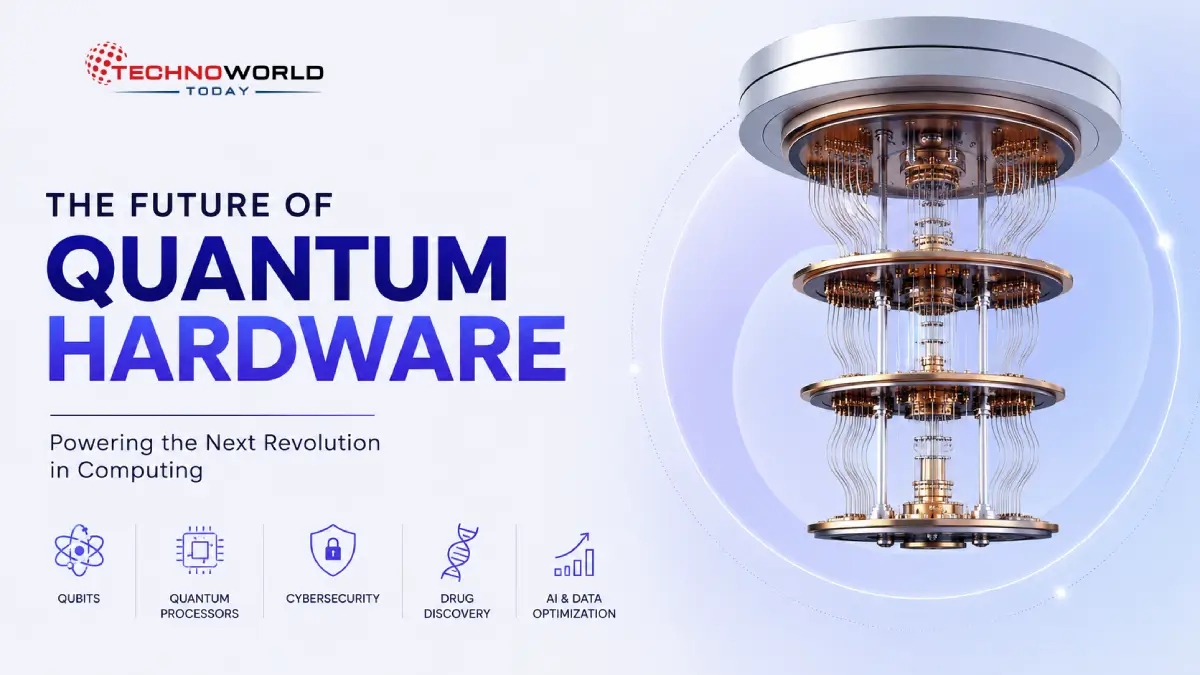
Quantum computing is no longer just a futuristic concept shown in sci-fi movies. It is becoming one of the most important technologies of this decade. While most people talk about quantum software and AI integration, the real revolution is happening inside the hardware itself.
The future of quantum hardware is where the actual battle is being fought.
Companies like IBM, Google, Microsoft, IonQ, and Rigetti Computing are investing billions into building faster, more stable, and scalable quantum processors. Governments are also heavily funding quantum research because whoever leads in quantum hardware could gain a major technological advantage in cybersecurity, AI, defense, healthcare, and scientific discovery.
In this blog, I’ll explain everything about quantum hardware in simple language — what it is, how it works, the biggest technologies behind it, current challenges, future possibilities, and why the world is betting so heavily on it.
What Is Quantum Hardware?
Quantum hardware is the physical system used to build and run quantum computers.
Traditional computers use bits that can either be:
- 0
- or 1
But quantum computers use qubits.
“A qubit can exist in a quantum superposition of both 0 and 1 simultaneously.”
This is possible because of quantum mechanics principles like:
- Superposition
- Entanglement
- Quantum interference
And this is exactly why quantum computers can solve some extremely complex problems much faster than classical computers.
But here’s the reality most people don’t understand:
Creating stable quantum hardware is unbelievably difficult.
Quantum systems are extremely sensitive to:
- Heat
- Noise
- Vibrations
- Magnetic interference
- Radiation
Even tiny environmental changes can destroy quantum calculations instantly.
That’s why quantum hardware is considered one of the hardest engineering challenges in human history.
Why Quantum Hardware Matters So Much
Without powerful hardware, quantum computing cannot become practical.
Right now, most quantum computers are still in the “experimental” stage.
Researchers are trying to improve:
- Stability
- Error correction
- Qubit quality
- Scalability
- Cooling systems
- Connectivity
The future of quantum computing depends more on hardware breakthroughs than software improvements.
If scientists successfully solve hardware limitations, quantum computers could revolutionize:
1. Artificial Intelligence
Quantum processors could potentially accelerate certain AI training and optimization tasks.
2. Drug Discovery
Scientists could simulate molecules perfectly and create life-saving medicines faster.
3. Cybersecurity
Quantum machines could break current encryption systems while also enabling ultra-secure communication.
4. Climate Research
Complex environmental simulations could become much more accurate.
5. Financial Modeling
Banks and financial institutions could process massive optimization problems in seconds.
6. Material Science
New batteries, superconductors, and advanced materials could be discovered much faster.
Major Types of Quantum Hardware
Different companies are building quantum computers using different hardware approaches.
Right now, there is no single “winning” technology.
Let’s understand the major quantum hardware architectures shaping the future.
1. Superconducting Qubits
This is currently the most popular quantum hardware technology.
Used by:
- IBM
- Rigetti Computing
These systems use superconducting electrical circuits cooled to temperatures colder than outer space.
Advantages:
- Fast operations
- Strong industry investment
- Easier integration with existing semiconductor technologies
Challenges:
- Extremely sensitive to noise
- Requires massive cooling systems
- Short coherence times
Despite challenges, superconducting qubits remain industry leaders because of their scalability potential.
2. Trapped Ion Quantum Hardware
Used by:
- IonQ
- Quantinuum
In this system, electrically charged atoms are trapped using electromagnetic fields.
Advantages:
- Very high accuracy
- Long coherence times
- Excellent stability
Challenges:
- Slower gate operations
- Difficult large-scale scaling
Many researchers believe trapped ions may become one of the most reliable quantum hardware technologies in the future.
3. Photonic Quantum Computing
This technology uses particles of light called photons.
Used by:
- PsiQuantum
- Xanadu
Advantages:
- Works closer to room temperature
- Faster communication
- Easier networking possibilities
Challenges:
- Difficult error correction
- Photon losses
Photonic quantum computing could become highly important for quantum internet systems.
4. Neutral Atom Quantum Hardware
Neutral atoms are controlled using lasers.
This technology is gaining huge attention because of:
- Scalability
- Lower error potential
- Room-temperature possibilities
Companies and researchers are rapidly investing in this field. Recent breakthroughs have improved operational accuracy significantly.
5. Topological Qubits
This is one of the most ambitious quantum hardware approaches.
Strongly associated with:
- Microsoft
Advantages:
- Theoretically more stable
- Naturally resistant to errors
Challenges:
- Still highly experimental
- Extremely difficult to build
If topological qubits succeed commercially, they could completely transform quantum hardware reliability.
The Biggest Challenge: Quantum Errors
Quantum hardware currently suffers from high error rates.
This is the biggest obstacle preventing practical large-scale quantum computing.
Qubits lose information very quickly due to:
- Environmental interference
- Noise
- Decoherence
That’s why researchers are heavily focused on:
- Quantum error correction
- Fault-tolerant computing
- Better materials
- Improved chip architecture
The industry is now entering what experts call the “fault-tolerant foundation era.”
The Future of Quantum Hardware
Now let’s talk about the most exciting part.
What will quantum hardware look like in the next 10 years?
1. Massive Qubit Scaling
Current systems have limited qubit counts.
Future systems may contain:
- Millions of physical qubits
- Thousands of logical qubits
- Advanced modular architectures
Researchers are already developing distributed quantum systems that connect multiple processors together.
2. Hybrid Quantum-Classical Computing
Quantum computers won’t completely replace classical computers.
Instead, future systems will combine both technologies.
Classical computers will handle:
- Standard tasks
- Data processing
- System control
Quantum processors will solve:
- Optimization
- Molecular simulation
- Complex calculations
Hybrid computing is becoming one of the strongest industry trends.
3. Quantum Data Centers
Right now, quantum computers are huge and expensive.
But in the future:
- Dedicated quantum data centers
- Cloud quantum platforms
- Enterprise quantum infrastructure
could become common.
Major tech companies are already offering cloud access to quantum systems.
4. Better Quantum Materials
Future breakthroughs may come from new materials rather than just better algorithms.
Scientists are developing:
- Advanced semiconductors
- Cryogenic electronics
- Ultra-low-noise materials
- Novel superconductors
New semiconductor research is already helping hardware survive extreme temperatures.
5. Quantum Internet Integration
Quantum hardware may eventually connect through quantum networks.
This could enable:
- Ultra-secure communication
- Distributed quantum computing
- Quantum cloud ecosystems
Many researchers believe quantum networking could become highly transformative in the future.
Will Quantum Computers Replace Normal Computers?
No. At least not anytime soon.
Quantum computers are specialized machines designed for very specific problems.
Traditional computers will still dominate:
- Web browsing
- Gaming
- Office work
- Mobile apps
- Everyday computing
Quantum hardware will mainly be used for:
- Scientific research
- AI optimization
- National security
- Drug discovery
- Complex simulations
Industries That Will Benefit Most
Healthcare: Faster drug discovery and personalized medicine.
Banking: Advanced fraud detection and portfolio optimization.
Cybersecurity: Quantum encryption and post-quantum security systems.
Logistics: Supply chain optimization and route planning.
Aerospace: Complex simulation and advanced material design.
Energy: Battery innovation and fusion research.
The Quantum Hardware Race Has Already Started
The global quantum race is becoming intense.
Countries like:
- United States
- China
- Canada
- Germany
are investing billions into quantum infrastructure.
The quantum computing market is expected to grow significantly over the next two decades.
Some reports estimate quantum computing could generate trillions in economic value by 2035.
Is Quantum Hardware Overhyped?
Partially yes — but also genuinely revolutionary.
Some companies exaggerate timelines.
Large-scale fault-tolerant quantum computers are still likely years away
But the progress happening right now is real:
- Better qubit fidelity
- Improved architectures
- Faster scaling
- Stronger investments
- Real commercial experiments
Quantum computing is slowly moving from research labs toward real-world business applications.
Also read this post:
Best Smart Devices for Daily Use
Simple Cybersecurity Habits That Can Save You from Hackers
Final Thoughts
The future of quantum hardware is one of the most exciting technological revolutions humanity has ever seen.
Right now, we are still in the early stages.
But the direction is very clear:
- More stable qubits
- Better error correction
- Scalable architectures
- Hybrid computing systems
- Commercial quantum infrastructure
The companies and countries leading this hardware race today may shape the future of AI, cybersecurity, healthcare, finance, and scientific discovery for decades.
Quantum computing is no longer just a theoretical dream.
It is becoming reality — one qubit at a time.
Frequently Asked Questions (FAQs)
What is quantum hardware?
Quantum hardware refers to the physical systems and devices used to build quantum computers. These systems use qubits instead of traditional bits
Why is quantum hardware important?
Quantum hardware is the foundation of quantum computing. Without stable and scalable hardware, quantum computers cannot solve real-world problems efficiently.
Which company is leading in quantum hardware?
Several companies are leading in different areas including IBM, Google, IonQ, and Microsoft
What are the biggest challenges in quantum hardware?
Major challenges include:
1. Error correction
2. Noise reduction
3. Qubit stability
4. Cooling systems
5. Large-scale scalability
Can quantum computers break encryption?
Yes. Powerful future quantum computers may break current encryption methods. However, researchers are already developing post-quantum cryptography to protect future systems from quantum attacks
What industries will quantum computing impact most?
Healthcare, finance, cybersecurity, logistics, aerospace, AI, and material science are expected to benefit the most.
How far are we from practical quantum computers?
Experts believe practical fault-tolerant quantum systems may still take several years or even decades to become mainstream